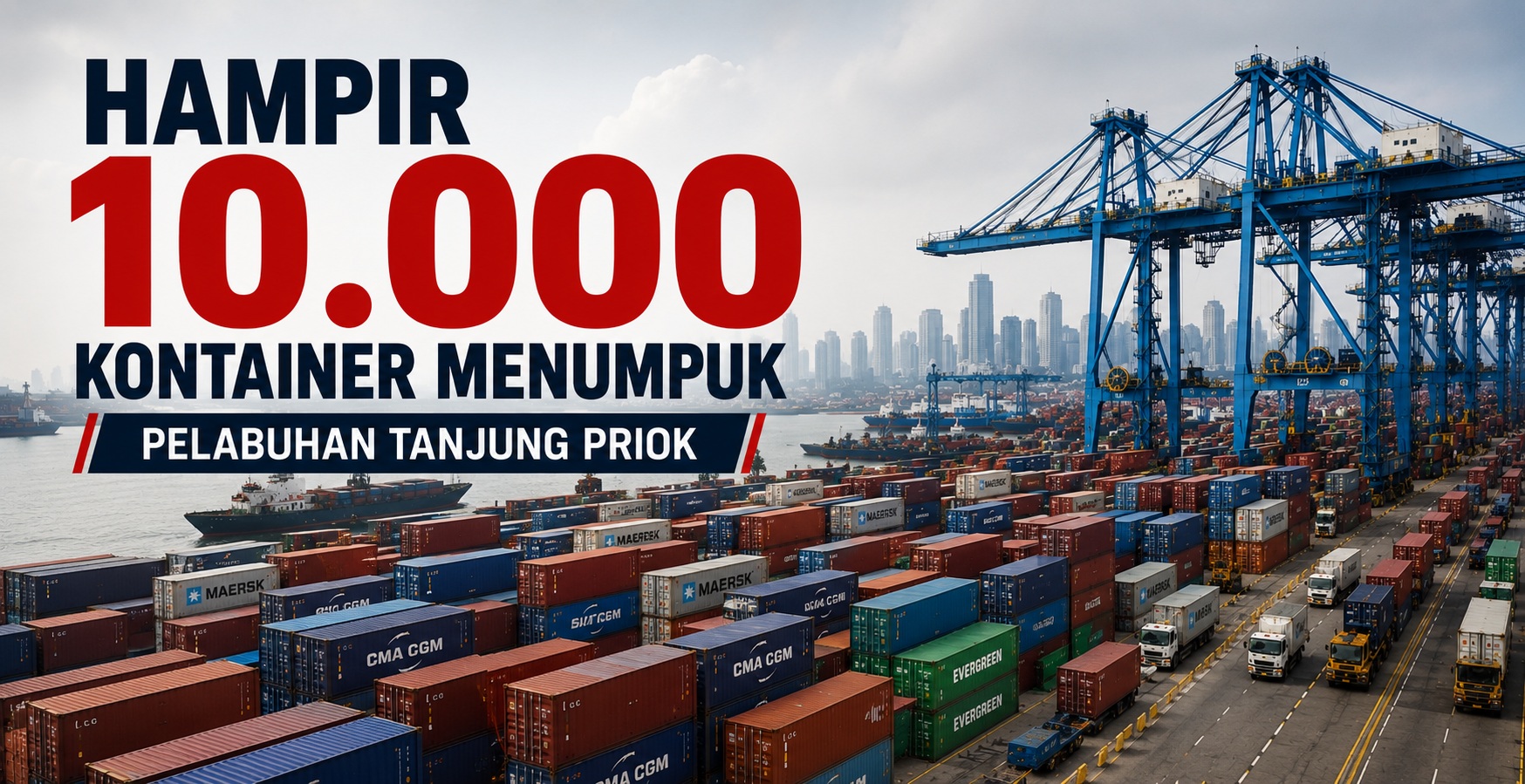
# 10,000 Containers Detained at Priok: A More Useful Lesson Than We Thought
Over the past month, one figure has continuously appeared in Indonesian logistics and automotive news: almost 10,000 containers were temporarily piled up at Tanjung Priok Port. It has been widely discussed in various forums and became a matter of national concern.
However, when we dig deeper, the story turns out to be far more useful than merely "who is at fault." There is a real lesson here for anyone involved in imports -- from vehicles to industrial project cargo.
## One Incident, Many Contributing Points
When traced more carefully, this congestion turns out not to be a matter of a single cause that is easy to pinpoint. The process is lengthy -- from ship docking, inspection, permit issuance, until goods actually leave the port area -- and each stage plays its own role. There are stages that run according to standard, and there are also stages that require more time due to high volume and inspection complexity.
This is actually good news for how we understand logistics problems: once we stop looking for a single party to blame, we can begin to see a more useful picture -- at which points a import process can slow down, and at which points we have control to speed it up.
## Points That We Can Actually Control
Beyond this specific case, there are several things that much more often become causes of daily import delays in Indonesia's logistics industry -- and the good news is, these are all things that can be planned and controlled from the start:
- HS Code errors -- incorrect tariff classification can trigger re-inspection or even goods detention
- Incomplete documents -- the most basic issue, but still the highest cause of delays
- Restrictions/prohibitions (lartas) licensing constraints -- certain goods require additional permits that if not prepared from the start, can bring the entire process to a halt
- Inadequately planned transportation -- truck fleets, warehouse slots, and goods release schedules that are not prepared in conjunction with the clearance process
This is not new for anyone who has been in imports for a long time. But it is important to repeat, because the Priok case serves as a reminder: delays can come from multiple points simultaneously, not just a single cause that is easy to blame.
## The Real Lesson
Whatever combination of factors plays a role in any given incident -- administrative processes, physical inspections, or internal planning -- there is one thing that is always true: the better prepared an import process is planned from the start, the smaller the impact if any one stage requires more time than anticipated.
This is where logistics infrastructure readiness becomes a determining factor. Having access to a bonded area or Bonded Logistics Center (PLB) ready to receive goods once the clearance process is complete means a business has flexibility, whatever happens at any stage of the process -- whether it is HS code clarification, additional documents, or inspection queues that are simply busy.
It is about having a plan that is ready to go, whatever the scenario.
## So, The Question Is
If your next container gets subjected to additional inspection, or there are documents that need to be revised at the last minute -- does your logistics process already have a backup route, or is everything dependent on the smoothest scenario?
---
TCI (PT Transcon Indonesia) operates in bonded logistics and project cargo. This article was created to share perspective based on official sources, not as a service promotion.